
On intellectual overconfidence, the mathematics of uncertainty, and why the more you actually know, the less certain you become, and why that is precisely the point.
There is a person you have met. You have met them in a classroom, at a debate competition, perhaps at a family dinner where someone decided that what the occasion really needed was an unsolicited opinion delivered with absolute conviction. They have an answer for everything. They speak first and loudest. They have never, to your knowledge, finished a sentence with the words “but I could be wrong.”
They are, in all likelihood, the least intellectually formidable person in the room.
This is not a provocation. It is, as it turns out, one of the most reliably documented findings in the psychology of human cognition, and it has some deeply uncomfortable implications for how we think about intelligence, education, and what it actually means to know something.
The graph that should haunt you
In 1999, two psychologists at Cornell University named David Dunning and Justin Kruger published a paper with one of the greatest titles in the history of academic research: “Unskilled and Unaware of It: How Difficulties in Recognising One’s Own Incompetence Lead to Inflated Self-Assessments.”(Kruger, Justin, and David Dunning, 1999) The paper was polite. The findings were savage.
What Dunning and Kruger demonstrated, across a series of studies, was that people with limited knowledge or skill in a given area tend to significantly overestimate their own competence, not because they are arrogant, but because the same skills required to do something well are the very skills required to recognise when you are doing it badly. If you cannot write well, you probably also cannot tell that your writing is poor. If you do not understand economics deeply, you probably do not appreciate the depth of what you are missing. Incompetence, in a cruel twist, comes with its own anaesthetic (Kruger, Justin, and David Dunning, 1999).
The graph that emerged from their research is now one of the most reproduced images in popular psychology.
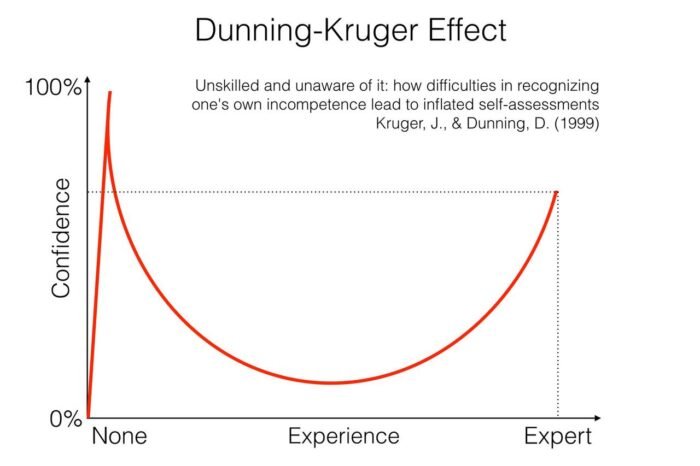
Confidence starts high, very high, among beginners. Then, as knowledge grows and the true complexity of a subject begins to reveal itself, confidence plummets. This valley is sometimes called the “valley of despair,” which is accurate and also rather dramatic (Kruger, Justin, and David Dunning, 1999). Beyond it, confidence rises again, but more slowly, more carefully, and permanently tempered by the awareness of how much remains unknown. The expert is not certain. The expert is merely better equipped to understand why certainty is not available.
“A little learning is a dangerous thing. Drink deep, or taste not the Pierian spring.” Alexander Pope said this in 1711. Dunning and Kruger proved it in 1999. Some things take a while to be confirmed empirically (The Poems of Alexander Pope, 1963).
The maths of knowing
Here is where it gets genuinely interesting, and where we need to borrow briefly from mathematics, not to intimidate, but because mathematics, at its frontier, makes the same confession that the wisest humans eventually make.
In 1931, the Austrian logician Kurt Gödel published his incompleteness theorems, which demonstrated something that shook the foundations of mathematics itself: within any sufficiently complex formal system, there will always be true statements that cannot be proven within that system (Gödel, Kurt, 2001). In other words, mathematics, the discipline we reach for when we want certainty, the language of the provable, is structurally, irreducibly incomplete. Some things are true which the system cannot, even in principle, confirm.
You do not need to understand the technical proof to feel the force of this. The single most rigorous intellectual enterprise in human history, the one that gave us calculus, quantum mechanics, and your phone, cannot guarantee its own completeness. If mathematics cannot be fully certain, what exactly is your classmate so sure about?
Werner Heisenberg arrived at a similar wall from a different direction. His uncertainty principle, formulated in 1927, established that the more precisely you measure a particle’s position, the less precisely you can know its momentum, and vice versa (Heisenberg, Werner, 1930). This is not a failure of technology. It is not that our instruments are not good enough yet. It is a fundamental feature of reality. Precision in one dimension necessarily produces uncertainty in another. The universe, at its most basic level, resists complete description.
What both Gödel and Heisenberg are telling us, from mathematics and physics respectively, is that the structure of knowledge itself contains irreducible unknowns. Not temporary gaps to be filled as we learn more. Permanent, principled limits on what can be known with certainty. And the people who have climbed highest in these disciplines are not the ones who forgot this. They are the ones who took it most seriously.
The education paradox
Now apply this to a school. Or a university. Or your own life.
There is a peculiar inversion that happens as education deepens. At the IB-MYP, IGCSE/GCSE or O-level stage, the world feels relatively knowable. You learn the causes of the First World War. You learn the formula for the area of a circle. You learn the periodic table. Everything has an answer, and the answer is in the textbook, and the textbook is what the exam tests. Confidence, rightly or wrongly, is high.
Then something strange happens. You go further. You specialise. You read the actual historians, not the textbook summaries, and you discover that they violently disagree with each other about the causes of the First World War. You study mathematics beyond the formulae and encounter problems that have resisted solution for centuries. You study biology and find that the more you learn about how a cell works, the more astonishing it becomes that anyone thought we had fully understood it.
The psychologist Stuart Firestein spent years studying what scientists actually do when they are working at the frontier of their fields. His conclusion was striking: the defining experience of expert scientific inquiry is not the satisfaction of knowing. It is the productive discomfort of not knowing, and learning to work well inside that discomfort (Firestein, Stuart, 2012). His book on the subject is titled, with admirable directness, Ignorance: How It Drives Science.
The Nobel Prize-winning physicist Richard Feynman put it more bluntly. He argued that the first requirement of genuine scientific thinking is the willingness to say “I don’t know” and that a scientist who cannot say those three words comfortably is not a scientist but a performer (Feynman, Richard P., 1998). The performance of certainty, Feynman suggested, is not a sign of knowledge. It is a sign of its absence.
“The whole problem with the world is that fools and fanatics are always so certain of themselves, and wiser people so full of doubts.” Bertrand Russell wrote this. He was, needless to say, fairly certain about it (Russell, Bertrand, 1998).
The cost of overconfidence
This is not merely an abstract philosophical point. Overconfidence has a body count.
In a landmark study of medical diagnosis, research found that physicians who expressed the highest confidence in their diagnoses were not the most accurate; they were, in several categories, the least accurate (Berner, Eta S., and Mark L. Graber, 2008). Confidence and competence had become decoupled. The doctors who were most useful to their patients were those who held their diagnoses provisionally, sought disconfirming evidence, and remained genuinely open to being wrong.
In the world of finance, Philip Tetlock spent twenty years studying the predictions of expert forecasters, economists, political scientists, analysts, and found that the most confident, most frequently quoted experts were systematically less accurate than their more cautious, uncertainty-acknowledging peers (Tetlock, Philip E., 2005). The people who appeared on television with the most assured predictions were, on average, worse at predicting than a simple statistical model. Tetlock called them “hedgehogs”, people who know one big thing and apply it to everything and contrasted them with “foxes,” who know many things, hold them lightly, and update readily when evidence changes (Tetlock, Philip E., 2005). The foxes won. They almost always do.
The pattern repeats across domains. In business, overconfident CEOs are more likely to overpay for acquisitions, underestimate project costs, and persist with failing strategies (Malmendier, Ulrike, and Geoffrey Tate, 2005). In geopolitics, overconfident leaders start wars they cannot finish. In classrooms, overconfident students stop asking questions, which is the most expensive intellectual mistake a young person can make.
The most intelligent thing you can do
So what does this actually mean for you, the student, the young person with ambitions and a lot of road ahead?
It means, first, that the most reliable signal of genuine intelligence is not confident answers. It is generous questions. The student who asks “but why does that actually work?” or “what are we assuming here?” or “has anyone found evidence that contradicts this?” is doing something far more intellectually valuable than the student who already has an answer and is waiting for their turn to deliver it.
It means, second, that intellectual humility is not weakness. It is a skill, and a rare one. The psychologist Carol Dweck, whose work on mindset we have encountered before, found that students who hold their current understanding provisionally, who treat knowledge as something to be built and revised rather than possessed and defended, consistently outperform their fixed-mindset peers over time (Dweck, Carol S., 2006). Uncertainty, held well, is not paralysing; it is propulsive.
It means, third, that the higher you climb, inevitably the stranger the view gets, and that is not a warning. It is the destination. The mathematicians who most deeply understand Gödel’s theorem are not distressed by the incompleteness of mathematics. They find it one of the most beautiful results in human intellectual history, because it reveals something true and surprising about the nature of thought itself. The physicists who most deeply understand Heisenberg are not frustrated by uncertainty. They have built an entire discipline, quantum mechanics, that is more accurate and more predictive than anything that came before it, precisely by taking uncertainty seriously rather than pretending it away.
Knowing less than you thought you did is not a step backwards. It is, almost always, a step forward. It means you have gone far enough to see what is actually out there.
“The greatest obstacle to discovery is not ignorance, it is the illusion of knowledge.” Daniel Boorstin wrote this. He was a historian, so he had access to a very long record of people being confidently wrong (Boorstin, Daniel J., 1983).
A not-so final thought
The next time you find yourself in a room with someone who has an answer for everything, who has never paused mid-sentence to reconsider, who has never said “I’m not sure, let me think about that” instead of rushing into being impressed, be curious about what they have not yet encountered.
And the next time you feel absolutely certain about something, pause. Ask yourself how you know. Ask yourself what evidence would change your mind. Ask yourself whether you have encountered enough of the territory to be drawing confident maps of it yet.
The smartest people you will ever meet are, almost universally, the ones who will tell you, with great specificity and genuine intellectual enthusiasm, exactly what they do not understand. That combination of precision and humility is not a contradiction. It is what practicing critical thinking actually looks like.
Intellectual performances built on certainty rarely survive prolonged contact with reality. Reality is simply too complicated, too layered, and too willing to expose the limits of our assumptions.
The goal, then, is not to become someone who always has the answer. It is to become someone who is endlessly interested in the questions. To learn deeply enough that your confidence is earned, and deeply enough still that your humility returns.
Protect your ability to change your mind. Pursue understanding without becoming attached to it. Learn enough to recognise how much remains unseen.
The point of education was never to become certain. It was to become capable of thinking. That is not a failure of conviction. It is what learning looks like.
Register for the HFA University Pathways July Event
Our inaugural workshop launches this July, bringing together an established community of high-achieving high school students. To preserve the cohort’s collaborative dynamic, we operate with a strict capacity cap, and final places are currently being taken.
Secure your place before registration closes on 5th July 2026 to participate and earn a certificate branded by LSE, Imperial College London, and HFA.
Works Cited
Berner, Eta S., and Mark L. Graber. “Overconfidence as a Cause of Diagnostic Error in Medicine.” The American Journal of Medicine, vol. 121, no. 5, Supplement, 2008, pp. S2–S23.
Boorstin, Daniel J. The Discoverers: A History of Man’s Search to Know His World and Himself. Random House, 1983.
Dweck, Carol S. Mindset: The New Psychology of Success. Random House, 2006.
Feynman, Richard P. The Meaning of It All: Thoughts of a Citizen Scientist. Perseus Books, 1998.
Firestein, Stuart. Ignorance: How It Drives Science. Oxford University Press, 2012.
Gödel, Kurt. “Über formal unentscheidbare Sätze der Principia Mathematica und verwandter Systeme I.” Monatshefte für Mathematik und Physik, vol. 38, 1931, pp. 173–198.
Heisenberg, Werner. The Physical Principles of the Quantum Theory. Translated by Carl Eckart and Frank C. Hoyt, University of Chicago Press, 1930.
Kruger, Justin, and David Dunning. “Unskilled and Unaware of It: How Difficulties in Recognising One’s Own Incompetence Lead to Inflated Self-Assessments.” Journal of Personality and Social Psychology, vol. 77, no. 6, 1999, pp. 1121–1134.
Malmendier, Ulrike, and Geoffrey Tate. “CEO Overconfidence and Corporate Investment.” Journal of Finance, vol. 60, no. 6, 2005, pp. 2661–2700.
Nagel, Ernest, and James R. Newman. Gödel’s Proof. Rev. ed., New York University Press, 2001.
Pope, Alexander. An Essay on Criticism. 1711. Reproduced in The Poems of Alexander Pope, edited by John Butt, Methuen, 1963.
Russell, Bertrand. “The Triumph of Stupidity.” Mortals and Others: Bertrand Russell’s American Essays, 1931–1935, vol. 2, Routledge, 1998.
Tetlock, Philip E. Expert Political Judgment: How Good Is It? How Can We Know? Princeton University Press, 2005.