
The Arithmetic We All Carry
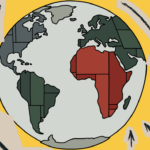
On a somewhat quiet Thursday evening, you might consider the power structures of the world and ponder a two-syllable buzzword, privilege. Privilege is often the not-so-invisible arithmetic that seemingly shapes our trajectories, or at least our perspectives. Consider this: as of February 2026, the world’s richest 10% hold 75% of global wealth, while the poorest half of humanity, some 4 billion people, clings to barely 2%, according to the World Inequality Report, 2026. Yet even those who might feel squeezed by rising costs or uncertain futures are, by global standards, profoundly advantaged.
If you’re reading this on a stable internet connection, perhaps in a home with reliable electricity, you’re among roughly 60% of the world’s population with such access, a stark contrast to the 2.6 billion who live without it. Or take education, the average reader here likely completed secondary school, a milestone achieved by only about half of adults in low-income countries. If you hold a Bachelor’s degree or higher, congratulations, you are among the 10% of the total global population that holds a tertiary degree. These are not indictments but invitations to reflection. Privilege isn’t a zero-sum game reserved for the ultra-wealthy; it’s layered, contextual, and universal in its reach. We all carry some measure of it (some maybe more than others), whether through geography, education, or the simple mathematical phenomenon of birth. What might seem like luck may just be mathematics, genetics, and community working in our favour. Acknowledging this doesn’t diminish our struggles; it sharpens our sight and allows us to be emotionally proactive, honest, and reliable.
Leadership as a Role, Not Merely a Position
From this vantage, leadership emerges not merely as a position but as a role, an extension of privilege itself, a sphere of influence amplified by access to power and control. A single mother in a Nairobi township, marshalling resources to educate her five children amid economic precarity, may embody more profound leadership than a joyless boardroom CEO whose decisions ripple through markets but rarely touch the lives of the vulnerable. Leadership is a role. It’s the orchestration of impact, where influence isn’t hoarded but deployed to uplift. In African contexts, this takes on added resonance during Black History Month 2026, marking the centennial of Carter G. Woodson’s Black History Week, a time to reflect on how figures like Fannie Lou Hamer wielded influence not from thrones but from the trenches of civil rights struggles. Or consider the Human Rights Day on March 21, 2026, which commemorates the Sharpeville Massacre of 1960 in apartheid South Africa and calls for human-centric approaches to dismantle systemic barriers. Privilege in leadership demands we question whose voices we elevate for the sake of the inadvertently silenced.
Stewarding Access, Choosing the Bridge
True leadership, therefore, lies in how we steward this access to power, to control, to spheres of influence. It is service rendered to those who entrust us with that role, whether through votes, loyalty, or circumstance. The World Inequality Report 2026 reminds us that gender disparities compound this; women earn just 32% of global labour income per hour compared to men, underscoring how privilege often intersects with structural and social realities, including gender. Yet in utilising it positively, we transform potential harm into collective gain: an HR manager who diversifies their recruits not for optics but for equity, the educator who mentors beyond their classroom, the activist who amplifies marginalised stories. Yet the picture is not static; privilege is shifting. In many African countries, women now outnumber men in university enrollment, with 113 women per 100 men globally as of 2023, according to UNESCO data. Sub-Saharan Africa is on track to achieve parity by 2036. This evolution demands that we not only acknowledge persistent gaps but also celebrate and build upon emerging equities, ensuring leadership adapts as these dynamics change. As Eric Morrison-Smith noted in his recent Guardian piece on Black History Month, “real resistance begins when ordinary people act, refusing to outsource power”. In 2026, amid economic uncertainty and climate disparities where the top 10% drive 77% of emissions, leadership’s imperative is clear: wield privilege not as a shield, but as a bridge. In serving others, we honour the full humanity of all.
Confronting Privilege
Sometimes, leadership means confronting privilege head-on and choosing how to wield it. As a shield, it can perpetuate inequalities and disruptions: the leader who hoards access, reinforcing divides between the advantaged and the underserved, or who uses influence to protect personal gain at the expense of collective progress. We see this in the corporate scandals of recent weeks, like the February 2026 revelations in the Financial Times about executive pay gaps in emerging markets, where top earners in African firms often outpace their workers by ratios of 300:1, entrenching economic rifts rather than bridging them. But as a bridge, privilege channels unified strength: the same leader, aware of their access, deploys it to connect resources, voices, and opportunities, fostering equity and shared advancement. This choice isn’t abstract; it’s the difference between leadership that divides and one that unites, as highlighted in the University of Washington’s recent blog on Black History Month reflections, where Dr Joyner emphasises that true progress demands honouring the generations who fought for dignity without the shields of privilege. The question for every leader becomes: are we using our platform to widen the circle or protect the centre?
Although another uncomfortable question lurks in the corner of one’s mind. What happens when you find yourself in a position of power but feel less privileged? The dynamics shift, often revealing leadership’s deepest tests. Here, the underprivileged leader, perhaps a woman navigating male-dominated boardrooms, or a first-generation executive from a marginalised community, or a young, talented student who penetrated a big corporation’s trust, must contend with imposter syndrome, heightened scrutiny, and the emotional labour of proving worth twice over. Take the example of Amina Mohammed, the UN Deputy Secretary-General, who in her February 2026 address at the Africa Leadership Forum, spoke candidly of rising from Nigerian roots to global influence, only to face biases that demanded she “overperform” to be seen as an equal. Or consider the young CEO of a Nairobi startup, profiled in the Guardian last week, who overcame socioeconomic barriers to lead a tech firm but now grapples with investor scepticism rooted in class perceptions. In these moments, leadership becomes an act of defiance: leveraging perceived disadvantage as a source of empathy, innovation, and authenticity. The less-privileged leader often brings unique perspectives, resilience forged in scarcity, and inclusive decision-making born from exclusion that enrich the role. But without systemic support, it risks burnout. True equity demands that those with more privilege actively dismantle barriers, ensuring power positions are not just accessible but sustainable for all.
Romanticising Struggle and Power
Yet the narrative of struggle in leadership is not always one of unalloyed virtue. Romanticising disadvantage risks overlooking its shadows: not every underprivileged leader channels hardship into empathy or authenticity; some carry resentment or insecurity that, unchecked, can damage teams and undermine trust. A leader who feels perpetually slighted might micromanage out of fear, stifling creativity, or withdraw from collaboration, isolating their vision. Conversely, privilege can insulate leaders from necessary self-correction, affording them the luxury of unexamined decisions, where accountability feels optional, and feedback is filtered through layers of deference. The 2026 McKinsey Global Institute report on African leadership dynamics notes that insulated executives in high-privilege roles often overlook blind spots, leading to 15–20% higher turnover in diverse teams due to unaddressed cultural missteps. True leadership, then, requires vigilance from all sides: the underprivileged must guard against bitterness eroding their influence, while the privileged must pierce their own insulation to embrace honest introspection. Only then does power become a tool for collective elevation rather than division.
In the end, navigating privilege is not about guilt or shame. It is about clarity. And clarity, once achieved, has a way of becoming courage. The kind of courage that turns personal advantage into collective possibility. That, perhaps, is the truest form of leadership at the edge.
The Bridge We Become
No matter where you stand today, whether the world has handed you a head start or asked you to run the race with stones in your shoes, leadership begins the moment you decide your story is not just yours to carry. Every advantage you hold is a temporary loan; every hardship you’ve endured is a forge. The real measure is not how far you’ve been given to go, but how far you choose to reach back. In the small, unglamorous acts of lifting someone else’s load, of listening when it’s inconvenient, of making space when the room feels full, you become the bridge you once needed. And in that single, deliberate motion, privilege or struggle alike are transformed: not into burdens or boasts, but into shared strength. The future doesn’t remember the shield; it remembers the bridge. That choice, yours, mine, ours, is where the story gets told.
Works Cited
Hannah Ritchie, Edouard Mathieu, Max Roser, and Esteban Ortiz-Ospina. “Internet.” Our World in Data, 2023, https://ourworldindata.org/internet.
Morrison-Smith, Eric. “Real Resistance Begins When Ordinary People Act.” The Guardian, 15 Feb. 2026, www.theguardian.com/commentisfree/2026/feb/15/black-history-month-real-resistance-ordinary-people.
Secretary-General. “Deputy Secretary-General’s Remarks at the 18th Annual Leadership Conference and Awards Ceremony [as delivered].” United Nations, 12 Feb. 2026, www.un.org/sg/en/content/dsg/statements/2026-02-12/deputy-secretary-generals-remarks-the-18th-annual-leadership-conference-and-awards-ceremony-delivered. Accessed 2 Mar. 2026.
UNESCO. “Record Number of Higher Education Students Highlights Global Need for Recognition of Qualifications.” UNESCO, 24 June 2025, www.unesco.org/en/articles/record-number-higher-education-students-highlights-global-need-recognition-qualifications.
University of Washington. “Black History Month Reflections: True Progress Demands Honouring Generations Without Shields of Privilege.” University of Washington Blog, 20 Feb. 2026, www.washington.edu/blog/black-history-month-reflections-true-progress-demands-honouring-generations-without-shields-privilege.
World Economic Forum. Global Gender Gap Report 2025. World Economic Forum, 11 June 2025, www.weforum.org/publications/global-gender-gap-report-2025/digest.
World Inequality Lab. World Inequality Report 2026. World Inequality Lab, 1 Feb. 2026, wid.world/world-inequality-report-2026.